
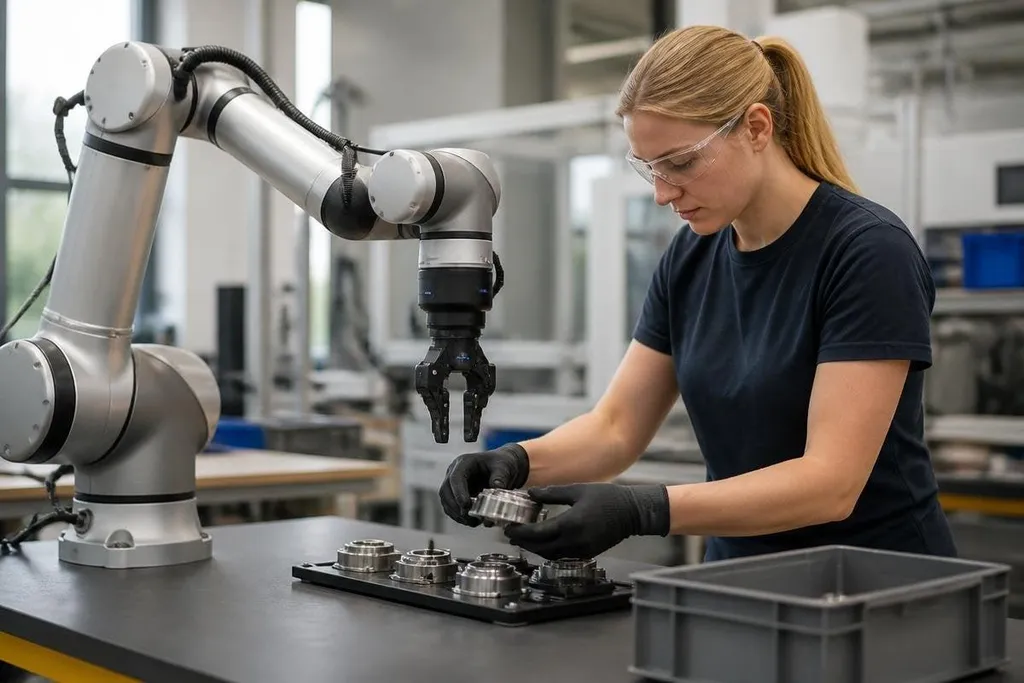
A collaborative robot, or cobot, shares a work area with people instead of working behind a fixed safety fence. That setup can work, but only when the robot, task, workspace, and human actions are designed as one safety system.
- A risk check comes before the robot reaches the floor.
- Speed limits, force limits, sensors, and stop controls handle different risks.
- A safe handoff needs clear space, clear signals, and trained workers.
Start with the task, not the robot
Safety begins with the job the cobot will perform. A robot moving small parts beside one trained worker creates different risks from one carrying sharp tools, lifting heavy loads, or working near several people.
A risk assessment should map the full task. It should cover where a person can stand, what the robot carries, where the arm can reach, and what happens after a power loss. The assessment also needs to include setup, cleaning, maintenance, and recovery after a stop.
That detail matters because a safe robot can become unsafe when the work changes. A new gripper, heavier part, altered arm path, or moved table can change the contact risk without changing the robot’s nameplate.
Use several layers of protection
No single sensor can handle every situation. A cobot may use joint force sensing to detect contact, cameras or other sensors to detect people, and software limits to keep the arm inside a defined work area.
Each layer handles a different problem. Force sensing can stop or slow the arm after contact. Presence sensing can keep the arm from entering a space when someone is there. Software limits can restrict speed, reach, and force before either event occurs.
The physical layout still matters. A fixed barrier may protect a person from a sharp tool, hot part, or fast-moving load even when the robot itself can work without a fence. Collaborative operation suits some tasks, not every task.
A visible emergency stop must sit where a worker can reach it quickly. The stop should also remove the relevant motion, and workers need a clear way to restart the system after checking the area.
Make human contact predictable
People and robots work more safely together when each one has a defined part of the task. The cobot might place a part in a marked area, then wait for a person to inspect it.
The person can return the part to another marked area, giving the robot a clear signal to continue. That handoff reduces guesswork. Floor marks, fixed trays, status lights, and simple controls help show where a person should stand and when the arm may move.
Training needs to cover normal work and abnormal work. A worker should know how to stop the cobot, what a warning means, how to clear a jam, and who can change the program. A person who has only learned the start button is not ready to recover a stopped cell.
A cobot’s stop test matters only when you know the sensor setup, task, site, and date. Robot24.com robotics coverage can put those details beside the safety claim before you check how the system behaves during daily work.
Check the limits in daily work
Safety settings can change during maintenance or program edits. A responsible site checks them after installation and again after changes to the arm, gripper, software, part, or workspace.
The check should use the real task. A cobot that moves safely with an empty gripper may create a different hazard with a metal tool or a loaded tray. The site also needs records showing who changed the settings and when the cell was checked.
I would not place a cobot beside a person until the full task has been checked under normal work, a stop, a restart, and a fault.
A practical safety check
Use this list before a cobot shares space with a worker:
- Map the reach: mark the arm’s full movement area, including the gripper and load.
- Check the load: record the part, tool, sharp edges, heat, and weight used in the task.
- Test the stop: confirm that the emergency stop cuts the intended motion and can be reached from the work position.
- Test the sensors: check detection with the real layout, lighting, clothing, and work pace.
- Train recovery: have workers stop, clear, reset, and restart the cell without bypassing a safety control.
- Record changes: repeat the risk check after a new tool, part, program, or table position is added.
The next useful step is a small supervised trial with the final tool and part, followed by a fresh check of every stop, sensor, and handoff point before wider use.